
Greasy Traffic Lanes
Repeated foot traffic can spread cooking oil beyond the line and into prep, storage, and exit routes. Degreasing breaks up this film so it can be recovered.
Serving Salt Lake City, Utah & surrounding areas
Open 24/7

Remove greasy buildup from restaurant tile and grout with a cleaning plan built around your floor, operating schedule, and safety needs.
Commercial Kitchen Floor Cleaning targets the grease, food residue, tracked-in soil, and detergent film that routine mopping can leave behind. These soils collect in grout lines, textured tile, corners, edges, and traffic lanes near cooking and warewashing areas. Over time, the floor can look dull and feel slick even when employees follow a daily cleaning schedule.
Salt Lake City Restaurant Cleaning provides restaurant floor cleaning services for kitchens that need more than a surface pass. Our team at Salt Lake City's local restaurant service plans the work around access, floor condition, equipment placement, drainage, and the hours when the kitchen can be taken out of use. The goal is a practical cleaning scope that fits the operation rather than a generic treatment.
Our location on West 600 South gives us direct access to central Salt Lake City and nearby commercial areas. Downtown restaurants often have tight back-of-house layouts and limited service windows. Sugar House businesses may have busy evening traffic that makes after-close work the sensible choice. In the Granary District, larger commercial spaces can require careful sequencing so wastewater, equipment, and drying areas remain controlled.

Effective restaurant floor degreasing starts with identifying the floor material and the type of buildup. Ceramic and quarry tile commonly tolerate alkaline degreasers, but concentration and dwell time still matter. A cleaner that is too weak may leave oily soil behind. A product that is too aggressive, allowed to dry, or mixed incorrectly can leave residue and affect grout or nearby surfaces.
The usual process begins with dry soil removal, followed by application of a compatible degreaser. The solution needs enough dwell time to loosen fats and oils before agitation. Grout lines, edges, corners, and the areas around fixed equipment receive focused scrubbing. Soil and spent solution are then recovered rather than pushed into another part of the room. The floor is rinsed as needed and left to dry before normal traffic resumes.
Kitchen floor degreasing is especially useful around cooking lines, fry stations, dish areas, prep zones, and routes used to carry waste. Each zone can have a different soil load. Treating them separately helps avoid spreading grease from a heavily soiled area across the rest of the floor.
Repeated foot traffic can spread cooking oil beyond the line and into prep, storage, and exit routes. Degreasing breaks up this film so it can be recovered.
Porous grout can hold grease and fine soil below the surface reached by a mop. Restaurant grout cleaning uses concentrated agitation along joints and edges.
Quarry tile and other slip-resistant surfaces contain low points that trap residue. Suitable brushes reach the texture without relying on excessive chemical strength.
Base edges, floor-to-wall transitions, and spaces near fixed equipment often need detail work because larger floor machines cannot reach them.
Overuse of cleaning product or incomplete rinsing can leave a sticky film that attracts new soil. The cleaning plan accounts for chemical residue as well as grease.
The floor around a drain may collect residue even when the drain itself functions properly. Cleaning is performed without treating the drainage system as a disposal point for uncontrolled soil.
We review the tile or flooring type, grout condition, greasy zones, access constraints, floor drains, fixed equipment, and nearby surfaces. Damaged grout, loose tile, failed coatings, and standing-water problems are identified because cleaning cannot repair them.
The work is planned for a period when food is secured, movable items are cleared, and kitchen traffic can stay out of the treatment area. Large floors may be divided into zones so each area can be cleaned, rinsed, and dried in order.
Food particles, packaging fragments, and dry soil are removed before wet cleaning. This prevents loose material from turning into slurry during degreasing.
A floor-compatible product is applied at the appropriate dilution and given controlled dwell time. Mechanical scrubbing and detail brushes work the solution into textured tile, grout joints, edges, and high-soil areas.
The loosened soil and cleaning solution are recovered. Rinsing is adjusted to the product and floor condition so detergent and suspended grease are not left behind.
The completed area is checked for remaining film and isolated trouble spots. Staff should keep traffic out until the floor is dry and any moved items can be returned safely.
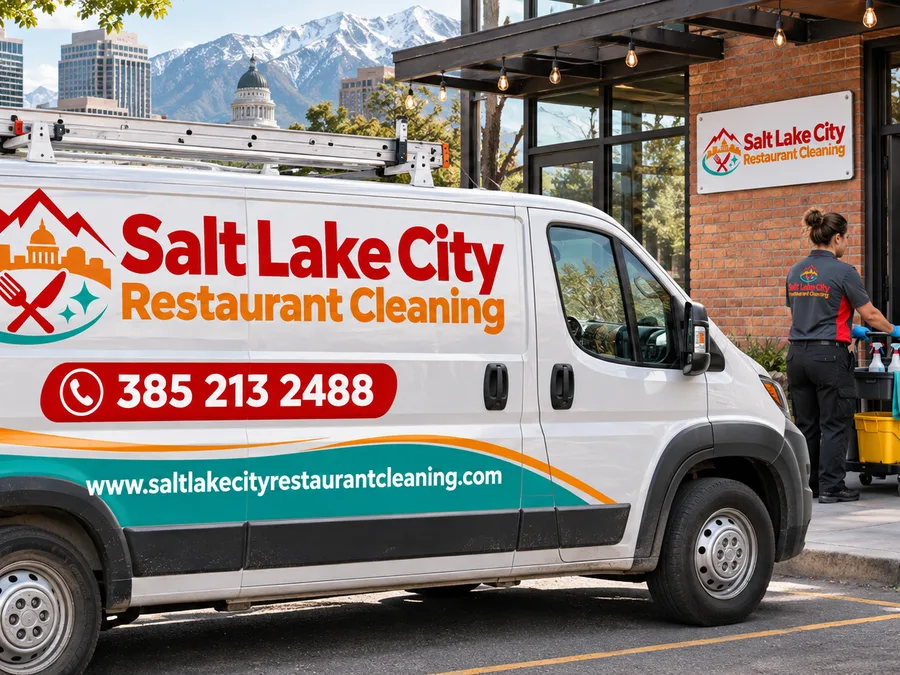
Restaurant floor cleaning in Salt Lake City often has to fit a narrow window between closing duties and the next prep shift. Downtown kitchens may have compact aisles, shared loading access, and little room to stage equipment. Sugar House restaurants can have long service periods that leave only late-night or early-morning access. Businesses near the Granary District may occupy larger commercial layouts where cleaning one zone at a time keeps the workflow controlled.
Winter also changes what reaches the floor. Snow, slush, deicing material, and street grit can be tracked through receiving doors and staff entrances, adding abrasive soil to existing kitchen grease. Entry routes and back-of-house traffic lanes may need extra dry-soil removal before degreasing begins. During dry periods, fine dust can mix with oil and create a stubborn film in grout and textured tile.
Scheduling should leave enough time for setup, treatment, recovery, and drying. A rushed cleaning that returns the floor to traffic while it is wet can undermine the work and create an avoidable slip concern. We discuss access and operating hours before the service date so the scope matches the available window.
Professional restaurant tile cleaning removes bonded soil; it does not repair a failed floor. Missing grout, cracked tile, loose transitions, peeling coatings, low spots, and drainage defects require repair by the appropriate trade. Heavy darkening in grout may also be permanent staining rather than removable soil. An inspection helps separate cleaning needs from material damage before expectations are set.
The safest cleaning chemistry depends on the surface. Alkaline degreasers are widely used against fats and oils, but natural stone, specialty coatings, epoxy systems, and some resilient floors may require different products or methods. Acidic cleaners are not interchangeable with degreasers and can damage cement-based grout or react with incompatible materials. Product labels, dilution instructions, dwell times, and safety data should guide use.
Commercial floor cleaning in Salt Lake City should support, rather than replace, the restaurant's daily sanitation routine. Employees still need to remove spills promptly, use correctly diluted product, change dirty cleaning solution, and keep tools assigned to appropriate areas. Periodic deep cleaning handles the embedded buildup that routine maintenance no longer removes.
Commercial kitchen floor cleaning in Salt Lake City typically costs about $0.35 to $1.25 per square foot, while small or heavily soiled kitchens may carry a minimum service charge of roughly $250 to $500. Basic open-floor cleaning sits toward the lower end; dense layouts, severe grease, and detailed grout work cost more.
Final pricing depends on square footage, soil level, floor material, equipment access, movable contents, service timing, wastewater recovery, and the number of treatment passes. The exact cost is confirmed after the floor and work conditions are assessed.
Describe the floor, problem areas, approximate size, and available service window to receive a cleaning scope built around your kitchen.
Call for a Free QuoteThe right frequency depends on grease production, traffic, floor texture, and the effectiveness of daily maintenance. A high-volume fry line may need professional degreasing more often than a light-prep kitchen. Visible darkening in grout, persistent tackiness after mopping, or grease spreading into adjoining zones are signs that routine cleaning is no longer removing the full soil load.
No, cleaning can remove embedded soil but cannot reverse permanent staining, worn grout, chemical damage, or missing material. Restaurant grout cleaning works best when the joints are intact and discoloration comes from grease and soil. We identify obvious damage before treatment so cleaning results are not confused with repairs.
The active work area should be out of service while chemicals, equipment, rinse water, and wet flooring are present. Many Salt Lake City restaurants schedule the work after closing or before prep begins. Larger kitchens may be divided into controlled zones if the layout and operating plan allow it.
Drying time varies with floor texture, grout porosity, ventilation, room temperature, humidity, and the amount of rinsing required. The service window must include drying rather than ending as soon as scrubbing stops. Staff should not return equipment or normal foot traffic until the treated area is dry.
No cleaning process can make a floor slip-proof. Removing greasy film and detergent residue may improve the condition of the walking surface, but slip risk also depends on flooring design, wear, spills, footwear, drainage, and daily maintenance. Any damaged surface or recurring standing water should be evaluated separately.
Movable floor mats, bins, carts, and small items generally need to be cleared from the treatment area. Fixed cooking equipment usually remains in place, with accessible edges cleaned as the layout permits. The pre-service scope should identify what restaurant staff will move and which areas cannot be reached safely.
Quarry tile and epoxy floors should not automatically receive the same chemistry or agitation. Quarry tile is textured and commonly paired with cementitious grout, while epoxy flooring can have manufacturer-specific limits and worn areas. The material is identified first, then the degreaser, brush, dwell time, and rinse process are selected accordingly.
Tell Salt Lake City Restaurant Cleaning about the floor material, grease buildup, grout condition, and operating schedule. We will help define a practical scope and suitable service window.